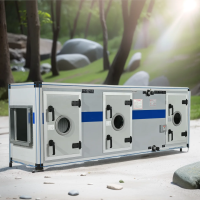
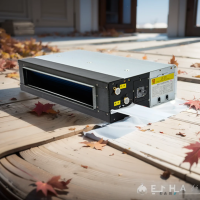
A chilled water fan coil unit is the terminal device that decides whether a hydronic HVAC system actually delivers the comfort it was designed for. Get the sizing, coil configuration or control strategy wrong, and even a perfectly specified chiller plant will underperform. This guide covers how a chilled water FCU works, the complete technical specifications across concealed, cassette and exposed model families, and a practical selection process — written from the engineering data of a manufacturer that has built fan coil units since 2008.
A chilled water fan coil unit transfers heat between room air and water circulating through a finned coil. Unlike a DX (direct expansion) unit, no refrigerant enters the occupied space — the refrigeration cycle stays entirely within the central chiller plant.
The operating sequence is straightforward:
In heating mode the same coil circulates hot water instead — commonly 60°C in traditional boiler systems, or 45°C in low-temperature heat pump installations. This dual-mode capability is why hydronic fan coil units dominate hotel, hospital and commercial office projects across Europe and Asia.
Why the 45°C figure matters. As heat pumps replace gas boilers, supply water temperatures are falling. A coil sized only for 60°C water will deliver substantially less heat at 45°C. Any manufacturer serious about heat-pump-ready projects should publish capacity at both temperatures — a point worth checking on every datasheet you review.
For any project with more than roughly 20 terminal units, or where F-gas regulations create long-term compliance cost, chilled water systems generally win on both lifecycle economics and regulatory simplicity.
Most manufacturer pages publish two or three figures. Below are the full performance tables across three product families, so your M&E engineer can size directly from this page.
Variable-speed EC motors with adjustable static pressure from 0 to 50Pa. This is the standard specification for projects targeting energy compliance.
Coil: 210mm height, 38.1mm width. Test conditions — cooling: chilled water in 7°C; heating: hot water in 60°C.
The cost-effective specification for residential and budget-sensitive commercial projects. Static pressure 30Pa.
Ceiling-recessed units with RS485 master-slave control as standard; one unit can network up to 32 units. Static pressure 12Pa.
Test conditions — cooling: air inlet DB 27°C / WB 19.5°C; heating: air inlet DB 20°C. Water pipe in/out: ZG3/4" — DN20.
For projects where the unit is visible. Five-speed EC motor, zero static pressure.
Aura efficiency ratings at High speed:
2-pipe systems circulate either chilled or hot water through a single coil, with the building switching seasonally between cooling and heating. Lower installation cost, simpler pipework, adequate for buildings with uniform load profiles.
4-pipe systems run separate chilled and hot water circuits, allowing one zone to cool while another heats. Essential for buildings with high internal gains on one facade and heat loss on another — common in mixed-use commercial developments.
Two 4-pipe coil arrangements are available:
Choose 3+1 where cooling load dominates and heating is a shoulder-season requirement. Choose 2+2 where both loads are substantial.
Step 1 — Calculate the room cooling load. Account for occupancy, lighting, equipment, solar gain through glazing, and fabric transmission. Do not size from floor area alone; a south-facing glazed office and an internal meeting room of identical size can differ by a factor of two.
Step 2 — Check the noise constraint before the capacity. This is the step most commonly reversed. Hotel guest rooms and hospital consultation rooms typically require below 30 dB(A). Once you fix that limit, only the fan speeds meeting it are available — and that determines which model sizes are genuinely usable. Selecting on capacity first and discovering the acoustic failure at commissioning is expensive.
Step 3 — Confirm the available static pressure. Ducted concealed units must overcome duct resistance, filters and grilles. Undersizing static pressure is a leading cause of airflow shortfall on site. EC motor units with 0–50Pa adjustable range provide commissioning headroom that fixed-speed AC units cannot.
Step 4 — Verify water-side hydraulics. Cross-check water flow rate and water pressure drop against your pump head calculation. A coil with excessive pressure drop in a long circuit can starve downstream units.
Step 5 — Match the installation format to the architecture. Concealed horizontal for suspended ceilings with duct space; cassette for exposed grid ceilings; ultra-thin concealed for retrofits with restricted plenum depth; exposed Aura or slim units where no ceiling void exists at all.
Chilled water FCUs lose performance gradually and invisibly. Three maintenance items account for most of the degradation:
Filter replacement. A clogged filter reduces airflow, which reduces capacity and can cause coil freezing in low-load conditions. Quarterly inspection in commercial environments; monthly in high-dust settings.
Coil cleaning. Fin surfaces accumulate dust that acts as thermal insulation. Annual cleaning restores heat transfer; neglected coils can lose 10–20% of rated capacity.
Condensate drain inspection. Blocked drain pans cause water damage and microbial growth. Check before each cooling season and confirm the pan falls correctly to the drain point.
Water quality. Corrosion inhibitor levels and system water chemistry deserve annual testing. Poor water quality damages coils from the inside, where inspection is impossible.
Every performance figure on this page is generated in-house. Yesncer operates a national-level enthalpy difference performance laboratory, a semi-anechoic chamber for acoustic measurement, a -30°C ultra-low temperature enthalpy difference testing laboratory, and a salt spray test room for corrosion durability validation. When your consulting engineer requests raw test data to validate a specification, it is available.
What is the difference between a chilled water fan coil unit and a hydronic fan coil unit? They describe the same equipment. "Hydronic" refers to the water-based heat transfer medium; "chilled water" specifies the cooling function. A hydronic fan coil unit running hot water in winter and chilled water in summer is simply a chilled water FCU operating in both modes.
Can a chilled water fan coil unit provide heating? Yes. The same coil circulates hot water for heating. Capacity depends on supply temperature — for example, the Aura M4 delivers 5,440W at 60°C water and 3,320W at 45°C. Always check the datasheet at the temperature your plant will actually deliver, particularly on heat pump projects.
What is the typical chilled water supply temperature? 7°C supply with 12°C return is the industry standard design condition, giving a 5K temperature difference across the coil. Some low-energy designs use elevated supply temperatures of 10–14°C to improve chiller efficiency, which reduces both sensible and latent capacity — coils must be resized accordingly.
How do I know whether to choose an AC or EC motor unit? Choose EC where energy regulations apply, where the unit runs long hours, or where low noise matters — EC units offer variable speed, lower power draw and adjustable static pressure. Choose AC where first cost dominates and operating hours are limited. The FCU-02EC draws 14W at 12Pa; a comparable AC unit draws 36W.
What noise level should I specify for a hotel guest room? Most 4- and 5-star hotel specifications require below 30 dB(A) in the occupied space at the operating fan speed. Units must be selected at a speed that meets this, not at maximum speed. The Aura M2 produces 21 dB(A) at Speed 1 and 22 dB(A) at Speed 2, leaving genuine headroom.
How often should filters be replaced? Quarterly in standard commercial environments; monthly in high-dust conditions such as construction-adjacent sites or industrial settings. Filter condition directly affects both airflow and delivered capacity.
Do you supply OEM or private-label fan coil units? Yes. Yesncer operates an established OEM/ODM programme covering panel finish and colour, brand logo and labelling, control interface options, coil configuration and export packaging, supported by a 40-person R&D team and rapid prototyping.
Specifying chilled water fan coil units for an upcoming project?
[Download Full Specification Sheet (PDF) →] [Request Project Selection Support →] [Contact Our Engineering Team →]